
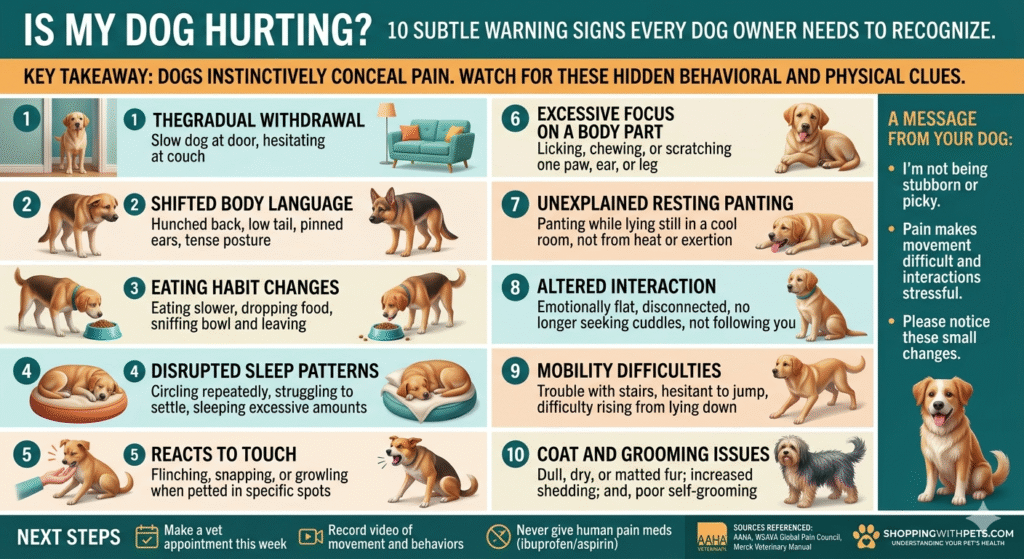
Blog Overview
Key Takeaways: Most dogs suffer in silence because their instincts are wired to conceal weakness, leaving owners completely unaware. Learning to spot the quiet, easy-to-miss warning signs of dog pain could save your pet from months of unnecessary suffering. This guide breaks down 10 behavioral and physical clues your dog may be hurting right now. Keywords: is my dog in pain, subtle signs of dog pain, how dogs show pain, dog pain behavior.
The Quiet Suffering Most Dog Owners Never Notice
Here is something that might surprise you: your dog has been trained by evolution to look fine even when they are not.
It is not manipulation. It is a survival instinct, a deeply embedded biological response that kept their ancestors alive in the wild. Showing pain meant showing vulnerability. Showing vulnerability meant becoming prey.
That instinct does not disappear just because your dog now sleeps on a memory foam bed and gets treats for sitting. It is still there, running quietly in the background, making your dog one of the most stoic creatures you will ever share your life with.
And that is exactly why dog pain is so frequently missed.
The American Animal Hospital Association notes that pain assessment in pets is one of the most challenging aspects of veterinary care, not because the signs are not there, but because they are subtle, gradual, and easy to rationalize away.
This guide is your decoder. Once you know what to look for, you will never look at your dog the same way again.
Want to learn more about what we do here? Check out our About Me page. And if something in this guide raises a concern about your pet, please do not hesitate to get in touch.
Why This Matters More Than You Think
Undetected pain does not just affect your dog’s comfort in the moment. Over time, chronic unmanaged pain:
- Elevates cortisol and stress hormones, weakening the immune system
- Disrupts sleep quality, accelerating cognitive and physical aging
- Creates secondary behavioral problems that get misdiagnosed as “attitude” or “stubbornness”
- Leads to muscle atrophy and mobility decline that becomes increasingly difficult to reverse
The earlier you catch pain, the simpler and less expensive the treatment. Most pain conditions caught in early stages are highly manageable. The same conditions caught months later often require complex, costly interventions.
10 Warning Signs Your Dog May Be in Pain Right Now
1. They Have Stopped Doing Things They Used to Love
This is the sign most owners miss because it happens so gradually.
Your dog used to sprint to the door when you grabbed the leash. Now they walk over slowly. They used to jump up on the couch every evening. Now they stand at the edge and hesitate. They used to bring you a toy when you got home. Now they barely lift their head.
This gradual withdrawal from activities they previously enjoyed is one of the earliest and most reliable signs of chronic pain. It is not a personality change. It is not “just getting older.” It is your dog quietly telling you that movement hurts.
2. Their Body Language Has Shifted
Healthy dogs carry themselves with a certain ease. Loose, relaxed posture, tail at a natural position, head held comfortably. Pain changes all of that.
Look for:
- A tucked or rigid abdomen
- Hunched shoulders or a rounded back
- Tail held lower than usual or clamped down
- Head drooping or held at an unusual angle
- Ears pinned back consistently (not just during thunderstorms)
You know your dog’s “normal” better than anyone. Trust yourself when something looks off.
3. Eating Has Changed
Pain and appetite are deeply connected. Dental pain makes chewing uncomfortable. Neck or shoulder pain makes bending to a floor bowl difficult. Gastrointestinal pain creates nausea that kills the desire to eat entirely.
Watch for:
- Eating slower than usual, or taking food and walking away before eating it
- Dropping kibble from their mouth while chewing
- Approaching the bowl, sniffing, then walking away
- Suddenly preferring soft food over hard kibble
Do not write off two or more consecutive days of appetite changes as “being picky.”
4. Sleep Is Disrupted
Dogs sleep a lot, between 12 and 14 hours a day for most adults. But the quality and pattern of that sleep matters.
A dog in pain may:
- Sleep significantly more than usual (pain is exhausting and depressing)
- Struggle to settle, circling repeatedly, lying down, getting up, repositioning
- Cry or whimper during sleep
- Wake suddenly, seeming confused or distressed
If your dog seems to sleep all day but wakes up looking more tired than rested, something may be disrupting their sleep from the inside.
5. They Flinch, Snap, or Growl When Touched
This one is critical and frequently misunderstood.
A dog who snaps when you touch their back, hip, ear, or belly is not being aggressive. They are telling you, as clearly as they can, that it hurts when you touch that spot. Pain-induced aggression is one of the leading causes of dog bites within families, including bites to children from dogs who have never shown aggression before.
If your dog has started reacting defensively to touch in a specific area, do not punish it. Investigate it. A vet visit is warranted immediately.
6. Excessive Focus on One Body Part
Dogs address pain the way they address everything: directly and physically. If something hurts, they lick it, chew it, scratch it, or paw at it.
If you notice your dog repeatedly returning to one area of their body, the same paw, the same ear, the same flank, they are trying to manage discomfort in that location. Check the area for visible signs like redness, swelling, warmth, a wound, hair loss, or unusual odor.
7. Panting Without an Obvious Reason
Panting after a walk, during hot weather, or during excitement is completely normal. Panting while lying still in a cool, quiet room is a red flag.
Unexplained panting at rest is a classic pain response, the body’s way of managing stress and discomfort. It is often one of the only visible signs in stoic dog breeds who refuse to show weakness in any other way.
If your dog is panting heavily without exertion or heat as a cause, take it seriously.
8. Changes in How They Interact With You
Dogs in pain often pull away from the people they love. Not because they are upset with you, but because interaction requires energy and movement that hurts.
You might notice your dog no longer seeks out cuddles, does not follow you from room to room like they used to, does not respond to their name with the same enthusiasm, or seems emotionally flat and disconnected.
This social withdrawal in an otherwise affectionate dog is one of the more heartbreaking signs of chronic pain, and one of the most commonly attributed to “just getting older.”
9. Trouble with Stairs, Jumping, or Getting Up
This one seems obvious, but many owners adapt to it without realizing what it means.
You start lifting your dog onto the bed instead of them jumping up. You stop taking them on long walks because they slow down too fast. You put water bowls on every floor so they do not have to do the stairs.
These adaptations are loving, but they can also be masking a pain problem that has been building for months or years. Mobility limitations in dogs are rarely “just age.” They are almost always pain that can be assessed and managed.
10. Coat and Grooming Changes
This one gets missed constantly.
Chronic pain elevates stress hormones, which affects coat health over time. A dog in pain may also stop self-grooming because the act of twisting and reaching to lick themselves hurts.
Signs to notice:
- Coat that has become dull, dry, or matted
- Increased shedding beyond seasonal norms
- Skin that looks irritated, flaky, or inflamed
- Areas of the coat that look unkempt, especially on their back half
What to Do Next
If you recognized three or more of these signs in your dog, make a vet appointment this week, not next month.
Before you go:
- Write down every sign you have noticed and when it started
- Take a short video of your dog moving, rising from lying down, and walking
- Note any changes in routine, food, environment, or recent incidents
This information dramatically speeds up the diagnostic process and helps your vet identify the source of pain faster.
One important warning: Never give your dog human pain medication, including ibuprofen, acetaminophen, or aspirin. These are toxic to dogs and can cause organ failure even in small doses. Pain management for dogs requires veterinary-prescribed medication.
💡 A Note from Our Research: The WSAVA (World Small Animal Veterinary Association) recommends that pain assessment be treated as a “fifth vital sign” in veterinary medicine, alongside temperature, pulse, respiration, and blood pressure. If your vet is not asking about pain indicators at routine checkups, it is worth bringing it up yourself.
Senior Dogs Deserve Special Attention
If your dog is 7 years or older, run through this list once a month. Pain conditions in senior dogs, particularly arthritis, dental disease, and cognitive decline-related discomfort, develop slowly and are notorious for being normalized by owners who love their dogs and do not want to see them aging.
Bi-annual veterinary checkups (every 6 months) are the current recommendation for dogs over 7. Annual checkups are no longer considered adequate for this age group by most veterinary organizations.
You Know Your Dog Better Than Anyone
Trust that knowledge.
When something feels different, even if you cannot quite name it, act on that feeling. Get it checked. Ask the question. Push for the answer.
Your dog has spent their entire life doing everything in their power to seem okay for you. The least you can do is pay close enough attention to notice when they are not.
If this guide raised concerns about your dog’s health, please reach out to us directly. We are happy to help point you in the right direction. And learn more about our mission on our About Me page.
Disclaimer
The content in this article is provided for general informational and educational purposes only. It is not intended as, and should not be construed as, professional veterinary medical advice, diagnosis, or treatment. Always seek the guidance of a qualified veterinarian with any questions you may have regarding your pet’s health, symptoms, or medical conditions. Reliance on any information provided in this article is solely at your own risk. shoppingwithpets.com assumes no liability for actions taken based on the content of this post. In the event of a pet health emergency, contact a licensed veterinarian or emergency animal hospital immediately.
Sources Referenced:
- American Animal Hospital Association (AAHA) – Pain Management Guidelines for Dogs and Cats
- World Small Animal Veterinary Association (WSAVA) – Global Pain Council Guidelines
- Merck Veterinary Manual – Pain: Introduction
- Colorado State University Veterinary Teaching Hospital – Canine Acute Pain Scale